- Learning is Fast
- Knowledge is Composed of Isolated Facts
- Being Good at a Subject is a Matter of Inborn Talent
- I'm Really Good at Multi-Tasking
Friday, October 26, 2012
How to Get the Most Out of Studying: Part 1
In the first of five short videos, Paul Chew, a cognitive psychologist at Samford University, points out the following beliefs that make you stupid.

Wednesday, October 24, 2012
Where is the Wisdom We Have Lost in Knowledge
Where is the wisdom we have lost in knowledge?
Where is the knowledge we have lost in information?
Consider how these words from T.S. Eliot's play "The Rock" might inform your view of information, knowledge, wisdom, and Life. How is information different from knowledge? What is the difference between knowledge and wisdom? Is there a difference between capital "L" Life and small "l" living?
I believe Eliot is reminding is that Life, the fullness and wholeness that Christ desires for us, rests not on information, or even knowledge, but relies on the wisdom cultivated by reflection, time, humility, and community.
Monday, October 22, 2012
The Best Sentence Ever

Ever feel incompetent or lost as a writer? ARC Consultant Drew Miller gives a hopeful glimpse into a college writer's mind.
I like writing perfect sentences. I’ve never done it.
Think
of something clever, Drew. No, I don’t like the way that sounds. No, that’s too
obvious. No that’s too cliché. There we go—one hour, one perfect sentence.
Perfect second sentences make first sentences even better.
Maybe
I can find a big word. Ecdysis. Jane Eyre is undergoing ecdysis. Beautiful.
This will give my mom chills. Even better, this will deconstruct all the lies I
learned in high school. Take that, Mr. Smith! I am the smartest.
Two Sentences down. Thesis now?
My
thesis doesn’t make any sense. My first two sentences don’t make any sense. I’ll
just take my thesis and keep thudding and tumbling down the page like a toddler
bumping his butt down stairs.
I
need a chair pillow.
Sometimes I write five pages, not knowing what I say.
I
need someone to read this paper over—this is rough. I want her to say, this is
amazing. I want her to say, get this published.
I can’t find my pen. Maybe I’ll listen to another song on
Spotify.
Can you read my paper?
She
‘s reading silently. What is she thinking? Oh, no! She wrote on my paper. Oh
no, she wrote again! I am going to
fail college. What is my mom going to do with me?
“Okay, Drew,” she says. “Good work. You have a few wordy
sentences, and I am a bit foggy on this part of the paper, but overall, it’s a
nice piece. Develop another draft with my comments in mind, and you’ll be
fine.”
Well,
maybe I can pass this class. Where’s my pen?
Friday, October 19, 2012
Felicity

"Felicity is a kind of happiness our culture does not, on the whole, promote: something like rational contentment, entailing acceptance, considered compromise, and self-knowledge."
"Happiness of this kind is, in fact, more a point of view than a state of affairs."McEntyre challenged me on many levels, including the value of using language with care, choosing interesting, specific, descriptive words rather than relying on easy hackneyed phrases, and recognizing that our language and life experience are inextricably interconnected.
"But felicity includes something beyond simple contentment. Felicity not only accepts what is, acknowledging and cheerfully submitting to the limitations of one's condition: it also unabashedly wills and seeks pleasure. Its pleasures are more subtle than sensational. Felicity comes in lively, sustained conversation; in long walks on which one notices small changes in the landscape; in the silent companionship of an old friend or partner; in serving a good inner to a family one loves."
"I think of felicity as a sign of wisdom."
"A felicitous word choice is one that so precisely names an idea or experience that it produces for the reader or hearer a shock of recognition, a surprised 'Yes! That's it!" and a gratifying sense of having put two interlocking pieces of a puzzling world perfectly in place."
"Precision of expression is neither taught nor appreciated in a culture that has prostituted language in the service of propaganda. To the degree that we consent to cheap hyperbole, flip slogans, and comfortably unexamined claims, we deprive ourselves of the felicity of expression that brings things worth looking at into focus -- things like happiness, for instance, which comes so much clearer and seems so much richer when we see it displayed in an array of colors: merriment, blitheness, gaiety, delight, contentment, joy, bliss, felicity itself....We can fall prey to the flattening of words and experience, and so diminish the variety and quality of happiness, or we can retrieve the words that name the forms of happiness that are worth pursing and, by returning them to good and careful use, rediscover felicity."
I invite you to join me in pursuit of felicity, in words and in life.
Wednesday, October 17, 2012
APA Style: 10 Tips and Troubles


The American Psychological Association
(APA) style for writing, formatting, citations, and references has many details
that are easily overlooked or forgotten. In this post, Jessica DePalatis
highlights ten key elements of the APA writing style elements. More details can be found on the Purdue Online Writing Lab (OWL) APA pages.
APA: 10 Tips and
Troubles
1. Little details
o Two spaces are needed after every
sentence. One inch margins are required for each page.
2. Headers
o On the first page in the upper left hand
corner you must put “Running head:” as well as a logical condensed version of
your title in caps. For all
proceeding pages just the condensed version in caps is needed. Every page must
have a page number in the upper right corner. Unlike MLA, your last name never
makes an appearance in the headers.
3. Titles
o The goal is to summarize your paper in no
more than twelve words. Do not beat around the bush. Blunt, boring honesty is
the key.
4. Abstract
o The abstract gets its own page right
after the cover page. It is not indented and contains between 150-250 words. It
is NOT the first paragraph of your paper. It is a summary of the whole paper,
so that a potential reader can know what they are getting into. It must be
short, sweet, and to the point.
5. Introduction
o At the top of the page after the abstract,
a title is needed. In a research paper the word "Introduction" is use. However, most college undergrads are compiling a literature review, not a research
paper. In this case the title presented on the cover page should be used.
6. In-text Citation
o The author’s last name and the year of
publication need to appear in the text whenever you mention someone else’s
ideas. This can take the form of a direct quote, paraphrase, or summary. Page
numbers are only needed when using a direct quote.
7. Quotes
o Quotes should be avoided at all cost.
They tell your professor that you did not understand the material enough to
paraphrase. A paraphrase must have different words, sentence structure and
meter from the original source. Anything else is a direct quote and must be
cited as such to avoid plagiarism.
8. Secondary Citations
o If you want to use an idea from someone
cited in another paper you have two options. First, it is best to find the
original article of the person you want to cite. Second, if you can’t find the
original article then you can cite the source as such: (Jones, as cited in
Smith, 2009). In this example the idea you want to use belonged to Jones but you
read about it in Smith’s paper. The year goes with Smith’s article.
9. References
o If you use someone else’s idea in your
paper you must cite it. If you cite it, the reference must show up in the
references section of your paper. If you have a source in your references
section your must have read it AND cited it in your paper.
10. DOIs
o DOIs are Digital Object Identifiers. Yes,
you need them. They can be a pain to track down if they do not appear on the
actual article. One tip is to find the DOI as soon as you select an article. Journal database websites often list the DOI among the stats with
the abstract. If worse comes to worst and no DOI is to be found, you can use
the homepage website of the journal that published the article (Retrieved from
www.homepage.come). DO NOT use the database website.
Tuesday, October 16, 2012
Grammar Tips
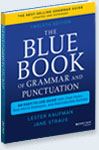 Interested in tips about grammar? Go to http://www.grammarbook.com/ and sign up for the free weekly newsletter.
Below is an excerpt from today's email:
That vs. Which
Last week’s grammar tip focused on the rules for using who vs. that. This week, we will learn the rules to guide us on when to use that vs. which.Rule 1: That may refer to people, animals, groups, or things. (As mentioned last week, who is preferred when referring to people.)
Rule 2: Which refers to animals, groups, or things.
Since that and which may each refer to animals, groups, or things, how do we know when to use that and when to use which?
Rule 3: That introduces essential clauses while which introduces nonessential clauses.
Example: I do not trust editorials that claim racial differences in intelligence.
We would not know which editorials were being discussed without the that clause.
Example: The editorial claiming racial differences in intelligence, which appeared in the Sunday newspaper, upset me.
The editorial is already identified. Therefore, which begins a nonessential clause.
NOTE: Essential clauses do not have commas surrounding them while nonessential clauses are surrounded by commas.
Example: Chess is a game that requires intense concentration.
The second part of the sentence is essential for conveying the meaning of the sentence.
Rule 4: If this, that, these, or those has already introduced an essential clause, you may use which to introduce the next clause, whether it is essential or nonessential.
Example: Those responses to the questions, which were not well thought out, eliminated him from further job consideration.
Monday, October 15, 2012
What Type of Student are You?

- Those who receive good grades but become no more productive than their friends who receive C's and D's;
- Those who receive good grades and who become deep learners, adaptive experts, great problem solvers, and highly creative and compassionate individuals;
- Those who receive mediocre grades but someday achieve phenomenal success because they did learn deeply, despite their transcripts;
- Those who receive poor marks, give up, and live a life that is largely dependent on others;
- Those who receive poor grades but tell themselves (without much evidence) that someday they will shine. (p. 10)
- Do you agree that Bain's categories describe the range of college students?
- Which type do you think describes you?
- If you're not a type 2 or type 3 student, what might be one step to move toward becoming a deep learner?
Subscribe to:
Posts (Atom)